Homepage › Solution manuals › David A. Cox › Galois Theory › Exercise 10.3.16
Exercise 10.3.16
Let be a point distance from a line . Put a marked ruler though with one mark at . When moves along , the other mark or (depending on which side of it is on) traces out the conchoid of Nicomedes.

We can relate the conchoid to constructions problems as follows.
- (a)
- Suppose we are given a point and lines , and assume that . Prove that a point is obtained by verging with and if and only if is one of the points of intersection of with the conchoid determined by and .
- (b)
- Prove that the angle trisection of (10.18) can be interpreted as the intersection of the unit circle with the conchoid determined by and .
- (c)
-
Suppose that
and
is the horizontal line
. Prove that the polar equation of the conchoid is
where the minus sign gives the portion of the curve above and the plus sign gives the portion below.
- (d)
-
Under the assumptions of part (c), show that the Cartesian equation of the conchoid is
By part (a), verging is the same as intersecting the conchoid with a line. Since the above equation has degree 4, this explains why verging leads to an equation of degree 4.
Answers
Proof.
- (a)
- Let . Then is obtained by verging with and if and only if there is a point such that , if and only if is on the conchoid.
- (b)
- As , with on , is on the conchoid determined by and , and on the unit circle, so is at the intersection of the unit circle and the conchoid.
- (c)
-
Here
and
is the horizontal line
, in the Cartesian coordinates system
.
If is any point on , then , where
The equation of the line is given for by :
thus
Let be the conchoid, and let the polar coordinates of a point where is a point in the line . Then
where , and may be positive or negative.
So the polar equation of the conchoid of Nicomedes is
where the sign of gives the two portions of the curve.
.
If , then and , so give the portion below the line , and give the portion above.
If , then and , so give the portion above the line , and give the portion below.
This is confirmed by the instruction "polar_plot" with Sage, where the blue and red portions of the conchoid are exchanged when and (see figure).
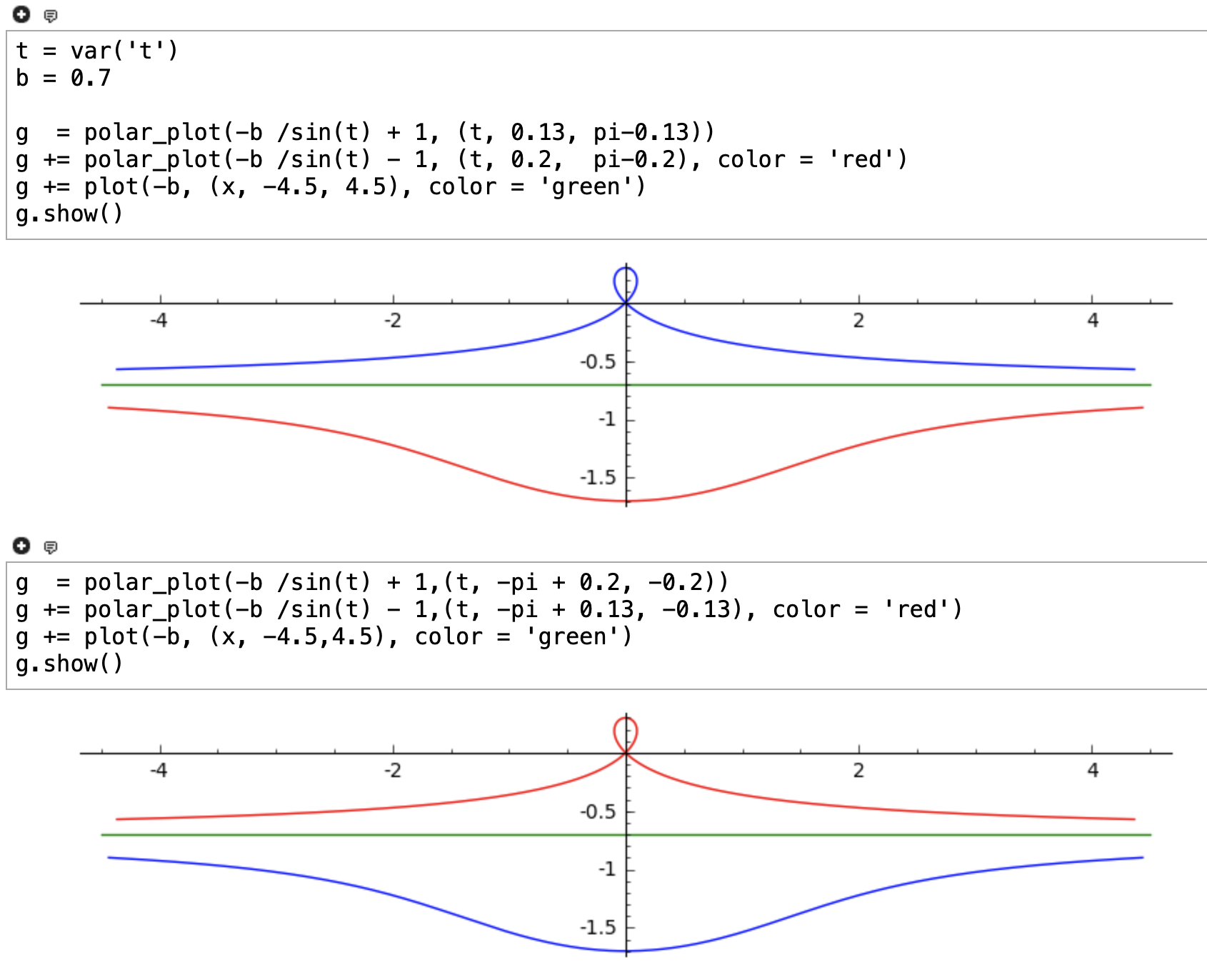
So, when traces , the mobile point passes through the infinity point of the curve when , and the two parts of the curve are traced with only one of the two formulas, for instance .
- (d)
-
Any non horizontal line
has an equation
, where
or
,
being the slope of
. The intersection point
of
with
is
, so, if
,
(The polar equation gives the same Cartesian equation. For ,
The sign in the text seems to be a misprint, if the equation of is (correct if the equation of is ).
