Homepage › Solution manuals › David A. Cox › Galois Theory › Exercise 7.5.10
Exercise 7.5.10
The goal of this exercise is to prove that the symmetry group of the octahedron is isomorphic to . By symmetry group, we mean the group of rotations that carry the octahedron to itself. We think of as acting on the octahedron.
- (a)
- Let be a vertex of the octahedron. Use the action of on and the Fundamental Theorem of Group Actions to prove that .
- (b)
- The eight face centers of the octahedron form the vertices of an inscribed cube. Explain why the octahedron and its inscribed cube have the same symmetry group.
- (c)
- The cube has four long diagonals that connect a vertex to an opposite vertex. Explain why the action of on these diagonals gives a group homomorphism .
- (d)
- Let be the rotations described in Example 7.5.1. Explain how each rotation acts on the inscribed cube and describe its corresponding permutation in .
- (e)
- Prove that the three permutations constructed in part (d) generates .
- (f)
- Use part (a) and (c) to show that . Also prove that is generated by .
See Section 14.4 for a different approach to proving that a group is isomorphic to .
Answers
Proof.
- (a)
-
Write
the set of the 6 vertices of the octahedron, with coordinates
and the group of rotations that carry to itself. acts transitively on , we can go from a vertex to a near vertex by a rotation of angle , the axe being orthogonal to the plane containing these two summits and . The orbit of a fixed vertex is so the whole octahedron :
Write the stabilizer in of the vertex .
Every rotation gives a permutation of the 6 vertices of the octahedron, thus fixes their gravity center . If , fixes and , so is a rotation of axis . Thus, if is the orthogonal plane of the axe , sends on itself. The restriction of to this plane is so a rotation that carry the square of vertices of which lie in this plane to itself. So it is a rotation of angle . As the rotation of axis is uniquely determined by this restriction, is so the set of 4 rotations of axis , and of angle .
The Fundamental Theorem of Group Actions gives then , thus
- (b)
- As a rotation is an isometry, sends the 3 points of a face of the octahedron on the three points of a face of the same octahedron, so sends the gravity center of a face on the gravity center of the image. The cube whose vertices are the center of the faces of the octahedron is so invariant by . Conversely if a rotation let invariant the cube , it let invariant the octahedron whose vertices are the centers of the 6 faces of the cube de , this octahedron is a dilatation of , thus . So is the symmetry group of .
- (c)
- As is an isometry, sends a long diagonal on a long diagonal, and two distinct long diagonal have not the same image. gives then a permutation of the 4 diagonals, numbered 1,2,3,4, and so induces a permutation of . The composition of two rotations corresponds to the composition of two permutations. So we obtain a group homomorphism
- (d)
-
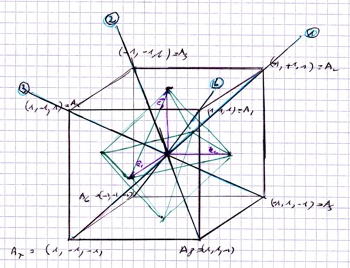
The cube of the centers of the faces of is a dilatation of a cube whose vertices are the points ,
We give an arbitrary numbering of the four long diagonals:
The rotation exchanges and , and also and , thus exchanges with , with :
gives the cycle , thus :
gives , thus :
- (e)
-
Let
.
contains . Moreover the two permutations generate , since generate generally. Thus :
- (f)
-
As the subgroup
contains
, it contains
. Therefore
So is surjective. Moreover , so is bijective, is thus an isomorphism.
As , where is an isomorphism,
