Homepage › Solution manuals › Dimitris Bertsimas › Introduction to Linear Optimization › Exercise 1.11 (Optimal currency conversion)
Exercise 1.11 (Optimal currency conversion)
Suppose that there are available currencies, and assume that one unit of currency can be exchanged for units of currency . (Naturally, we assume that .) There also certain regulations that impose a limit on the total amount of currency that can be exchanged on any given day. Suppose that we start with units of currency 1 and that we would like to maximize the number of units of currency that we end up with at the end of the day, through a sequence of currency transactions. Provide a linear programming formulation of this problem. Assume that for any sequence of currencies, we have , which means that wealth cannot be multiplied by going through a cycle of currencies.
Answers
We model the amount of currencies exchanged from the currency , for a currency , , by . Our goal is to maximize the amount of currency in
under the condition that current regulations impose a limit on the total amount of currency that can be exchanged on any given day:
and that we have a starting amount of currency :
Obviously, we cannot exchange more currency from to other currencies than we changed to before:
and no currency will be exchanged for currency 1 or from currency N:
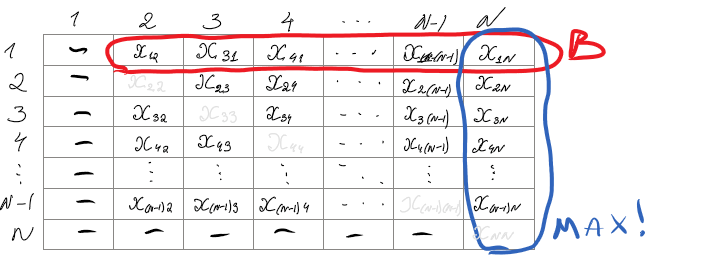
These conditions result in the following linear optimization problem:

Comments
-
In the third last constraint after the sign greater than equal to there should not be summation (k=1to N) (xik), instead of xjk, because the the currency converted to currency i is more than the currency converted from i to currencey kjfatima • 2023-11-07
-
Why in objective function, we have xjN, instead of xiN and riN?jfatima • 2023-11-07