Homepage › Solution manuals › Dimitris Bertsimas › Introduction to Linear Optimization › Exercise 1.14
Exercise 1.14
A company produces and sells two different products. The demand for each product is unlimited, but the company is constrained by cash availability and machine capacity.
Each unit of the first and second product requires 3 and 4 machine hours, respectively. There are 20,000 machine hours available in the current production period. The production costs are $3 and $2 per unit of the first and second product, respectively. The selling prices of the first and second product are $6 and $5.40 per unit, respectively. The available cash is $4,000; furthermore, 45% of the sales revenues from the first product and 30% of the sales revenues from the second product will be made available to finance operations during the current period.
- (a)
- Formulate a linear programming problem that aims at maximizing net in come subject to the cash availability and machine capacity limitations.
- (b)
- Solve the problem graphically to obtain an optimal solution.
- (c)
- Suppose that the company could increase its available machine hours by 2,000, after spending $400 for certain repairs. Should the investment be made?
Answers
- (a)
- We denote the number of units of the first product by
and the number of units of the second product by ;
both are nonnegative real numbers. Our goal is to maximize the profit
(not revenue) function given by
under the condition that the total machine hours capacity does not exceed twenty thousand hours
and 45% of the revenues for the first product as well as the 30% of the sales revenues from the second product plus the fixed amount of are available for operations
This results in the following linear optimization problem:
(1) - (b)
- Since all quantities are nonnegative, we only work in the first
quadrant. The first constraint is the area below the function
,
the second constraint is the area below the function
.
The feasible region is then the intersection of both areas. Classes of
characterised by the same profit are marked via red lines
, where
is
the corresponding net income (they are the isolines of the three-dimensional graph
which is monotonically increasing with both
and
).
In the figure below, the feasible region is dark green, whereas the objective
function isolines are marked red.
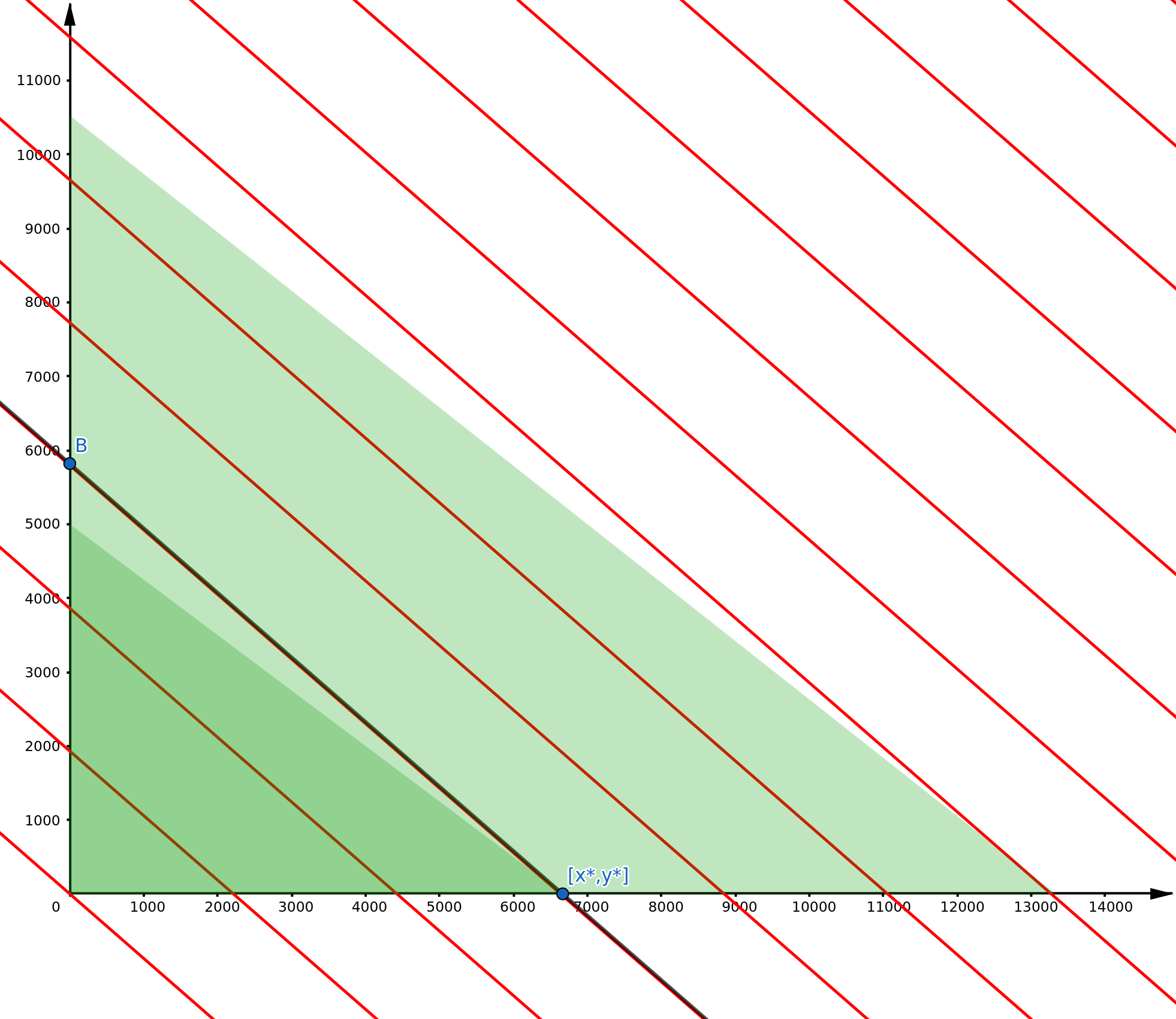
As we can see, the second constraint () is redundant and will not be considered from here on. The optimal cost (highest isoline touching the feasible region) emerges from the corner solution . This results in the optimal profit of .
- (c)
- The new constraint is .
Modifying our sketch (the old constraint is dark green, the new constraint is
light green), we obtain:
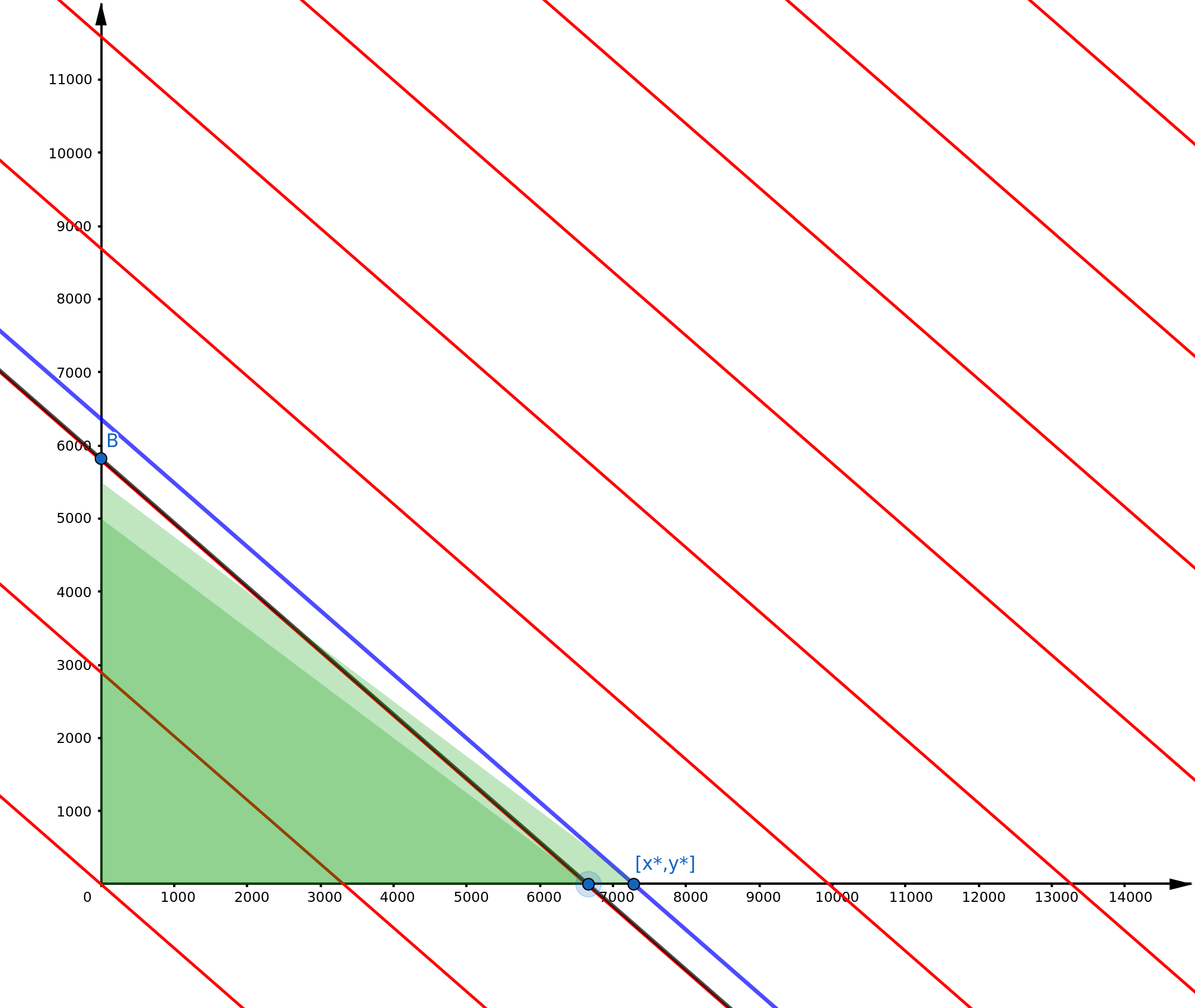
The optimal solution has now shifted to the point , resulting in the optimal net income of . The increase in profit is thus , which exceeds the costs associated with the investment. Thus, the company should invest in machine reparations.