Homepage › Solution manuals › Dimitris Bertsimas › Introduction to Linear Optimization › Exercise 2.14
Exercise 2.14
Let be a bounded polyhedron in , let be a vector in , and let be some scalar. We define
Show that every extreme point of is either an extreme point of or a convex combination of two adjacent extreme points of .
Answers
By definition, we can write as for some matrix and an -dimensional vector . Since is just with one more additional hyperplane constraint, we can write as
In other words, the resulting figure is another polyhedron inside and since it always intersects the edges of , its own extreme points will either be the extreme points of or will strictly lie on the edges of as demonstrated in the figure below. We formalize this intuition.
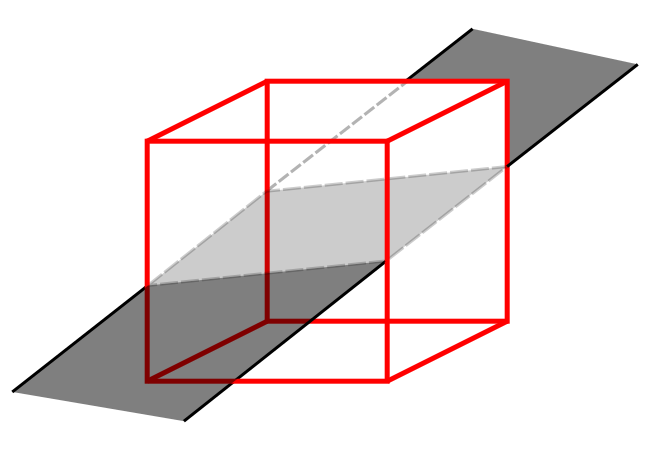
Proof. If is empty, the assertion is trivial. Else, let be an arbitrary extreme point of . By Definition 2.9, out of the active constraints in are active. But is also an element of ; We have two cases.
If the newly added condition is linearly dependent in , then, even after excluding it, still has linearly independent active constraints in as well; thus, is an extreme point of .
If, however, has linearly independent constraints after excluding the new condition , then all of the vectors , , lie in a proper subspace of and there exists a nonzero vector such that , for every . The scenario is similar to the setting of Theorem 2.6, yet the condition is stronger - is bounded. We modify the proof a little. Let us consider the line consisting of all points of the form , where is an arbitrary positive scalar. For , we have . Thus, those constraints that are active at remain active at all points on the line. However, since the polyhedron is assumed to be bounded, it follows that as we wary in two directions, some constraints will be eventually violated. At the points where some constraints are about to be violated, a new constraint must become active, and we conclude that there exits some and some such that
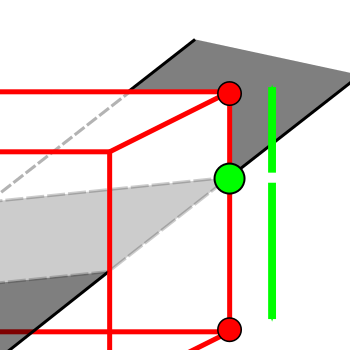
The obtained columns and are linearly independent of the vectors , . Indeed, we have and (by the definition of ). Thus, . On the other hand, for every (by definition of ) and therefore, is orthogonal to any linear combination of the vectors , . Since is not orthogonal to and , we conclude that is not a linear combination of the vectors , . Thus, the points and are two adjacent vertices of and we have
as desired. □
Comments
Assume . Let be a matrix and a vector such that . Let be an extreme point of , equivalently it is a basic feasible solution. Therefore and there are linearly independent active constraints at (possibly including in these constraints).
If it is possible to find linearly independent active constraints at all in the collection , it implies that is an extreme point of too.
Otherwise there are only linearly independent active constraints in the set of constraints , which means that lies on a face of dimension 1 of Let be the direction of the face on which lies. Since is bounded, there exist scalars such that and are the two vertices (extreme points) of the segment is on. Therefore is a convex combination of these two vectors.

Comments
-
Hello, I didn't understand very well the part where it is mentioned that "Otherwise there are only $n-1$ linearly independent active constraints in the set of constraints $A\hat{x} \leq d$". It is not so clear to me why it is possible to ensure that proposition, could you please explain to me?BSupreme • 2024-04-17
-
To Nicolas: because $a^Tx=b$ is just one single extra constraint defining Q besides the constraints defining P.GT_Buzz • 2024-08-27