Homepage › Solution manuals › Dimitris Bertsimas › Introduction to Linear Optimization › Exercise 2.20*
Exercise 2.20*
Consider the Fourier-Motzkin elimination algorithm.
- (a)
- Suppose that the number of constraints defining a polyhedron is even. Show, by means of an example, that the elimination algorithm may produce a description of the polyhedron involving as many as linear constraints, but no more than that.
- (b)
- Show that the elimination algorithm produces a description of the one-dimensional polyhedron involving no more than constraints.
- (c)
- Let ,
where
is a nonnegative integer. Consider a polyhedron in
defined by the
constraints
where all possible combinations are present. Show that after eliminations, we have at least
constraints. (Note that this number increases exponentially with )
Answers
- (a)
- Let
be the number of inequalities of type (2.4),
be the number of inequalities of type (2.5) and
be the number of inequalities of type (2.6). Since we have to make
sure that each of the inequalities of type (2.5) is compared to each of
the inequalities of type (2.4), the resulting number of constraints in
is
(where
we have ).
We argue that this amount reaches its maximum for
and
.
Proof. We induct on the original number of constraints .
-
For we consider all possible cases of and obtain
where in we have not considered the case of two inequalities of type (2.8) as this would result in a trivial projection.
-
Now suppose inductively that we have proven this for some . We then have, for all , :
Now we give a very trivial example of the sharpness of the bound in case that is even. Consider the two-dimensional polyhedron with constraints:
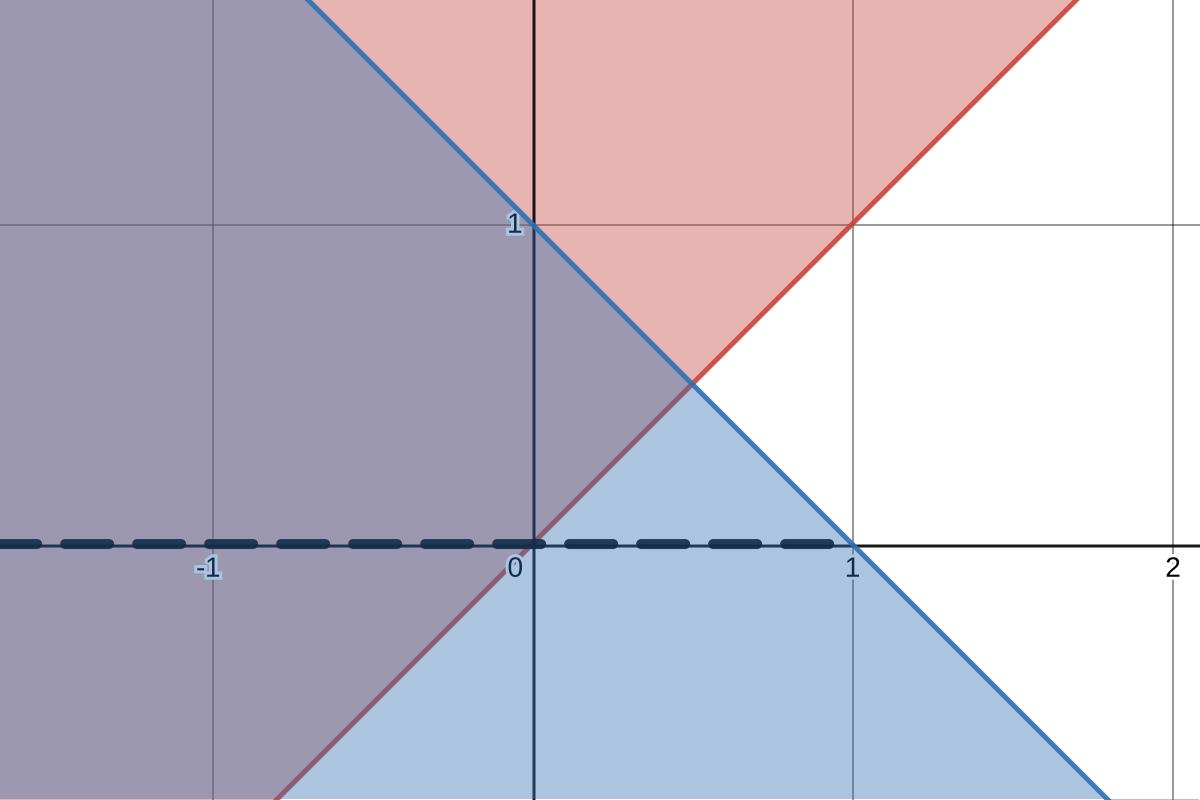
Figure 1: Polyhedron defined by (red area) and (blue area) and its projection. We then obtain inequalities
resulting in an unbounded one-dimensional polyhedron with constraint.
Applying the previous part to the number of constraints at dimension , we obtainProof. We induct on the dimension of the polyhedron.
-
Let . Then we only apply the projection once and the assertion follows from part (a) of this exercise.
-
Now suppose that we have a polyhedron in dimensions. Applying the Fourier-Motzkin elimination algorithm, we obtain a polyhedron in dimensions with at most constraints. We can apply the induction hypothesis and conclude that the Fourier-Motzkin projection involves at most
constraints.
 2022-01-30 07:39
Comments
-