Homepage › Solution manuals › Dimitris Bertsimas › Introduction to Linear Optimization › Exercise 3.1 (Local minima of convex functions)
Exercise 3.1 (Local minima of convex functions)
Let be a convex function and let be a convex set. Let be an element of . Suppose that is a local optimum for the problem of minimizing over ; that is, there exists some such that for all for which . Prove that is globally optimal; that is, for all .
Answers
Proof. Let be a local minimum for , i.e., there is an such that whenever , we have . Suppose for the sake of contradiction that is not a global minimum, i.e., there exists another element such that . Consider the line segment between and :
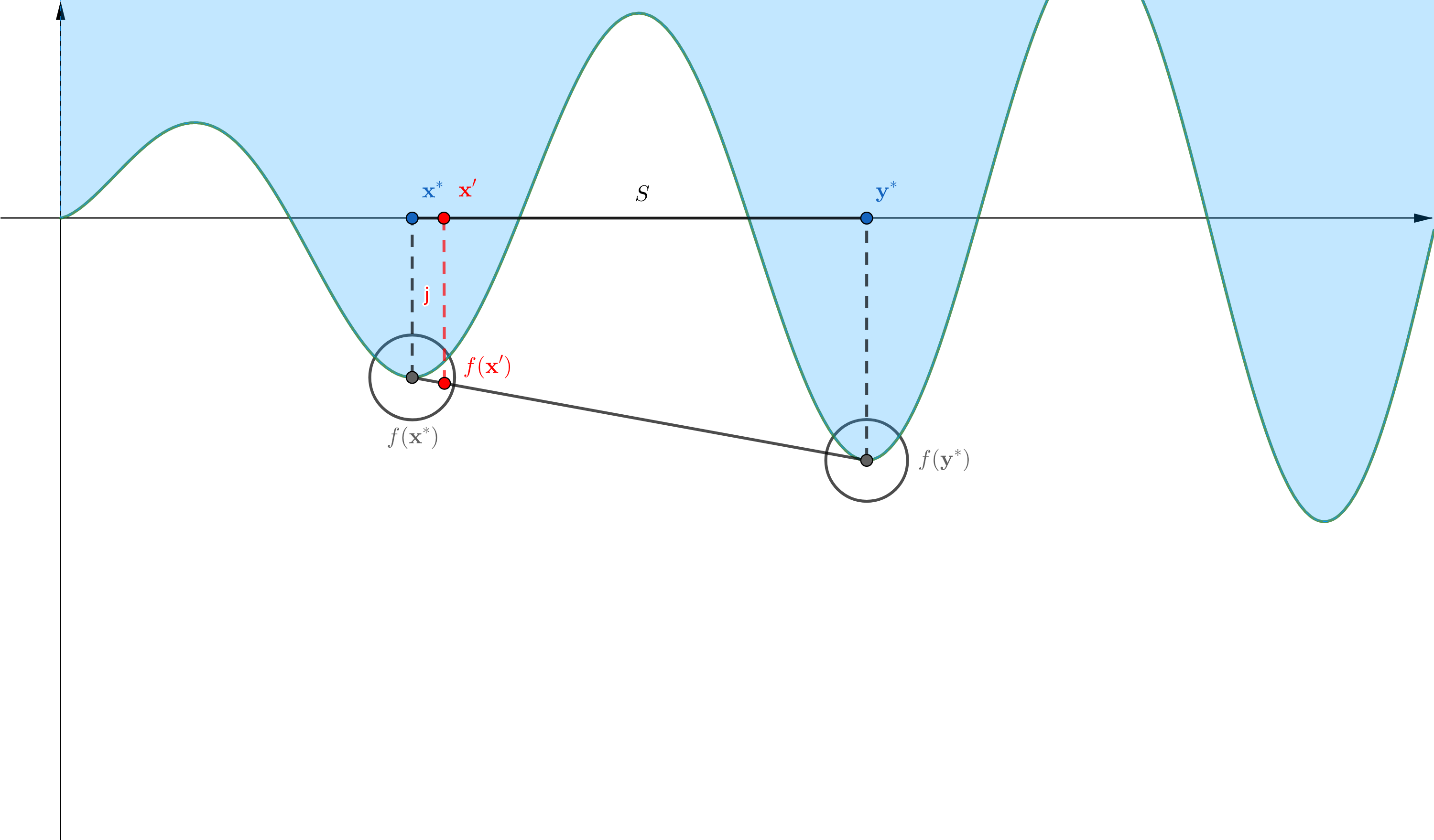
This line is entirely contained in by the convexity assumption. Furthermore, the elements of this line can get arbitrarily close to :
But the resulting combination creates a weighted average of and which is obviously less that alone:
In other words, we have found a point in the -neighbourhood of such that . This is a contradiction to the fact that is a local minimum in its -neighbourhood. □