Let be elementary sets.
Show that their union ,
intersection , the difference
and the symmetric difference
are also elementary.
Show that for any
the translate
is also an elementary set.
Answers
Proof.By definition, we can represent both sets as unions
and
for some boxes
and
in
.
(i)
The first assertion is obvious. Denote
for
and
for
. Then obviously
and since
are boxes,
must be elementary by definition.
(ii)
The best way to prove the assertion "the intersection of two elementary sets iselementary" is to reduce it to the assertion "the intersection of two boxes isagain a box". The validity of the reduction can be shown using several set-theoretic laws:
Thus,
is a finite union of box intersections. Now we demonstrate that the intersection of boxes remains a box.
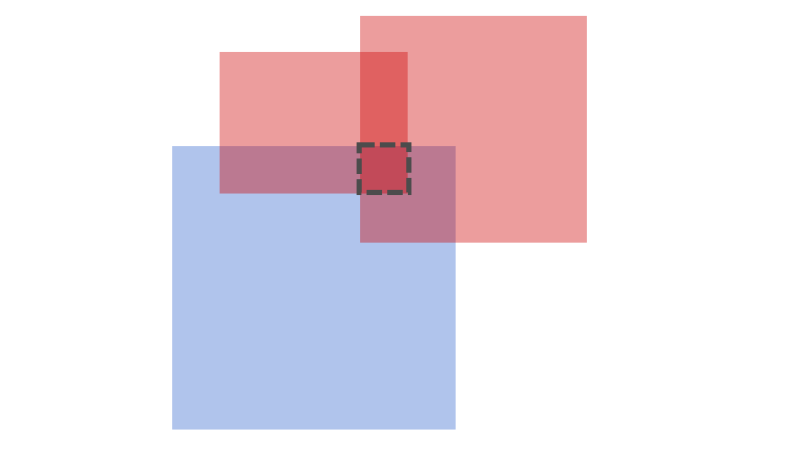
Figure 1: Intersection of boxes in
.
Pick an arbitrary intersection
of two boxes
. By definition
for some
. By definition of intersection
Since
the above set is a box by definition.
(iii)
We will use the strategy of reducing the given assertion about the elementary sets to an identical assertion made about boxes. In this case, we have
By parts (i) and (ii) of this exercise, it suffices to prove the assertion for an arbitrary box difference
.
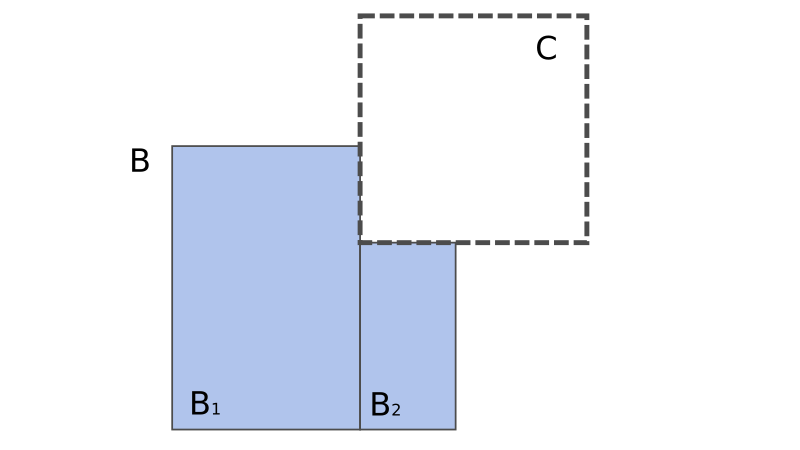
Figure 2: Set difference of boxes in
.
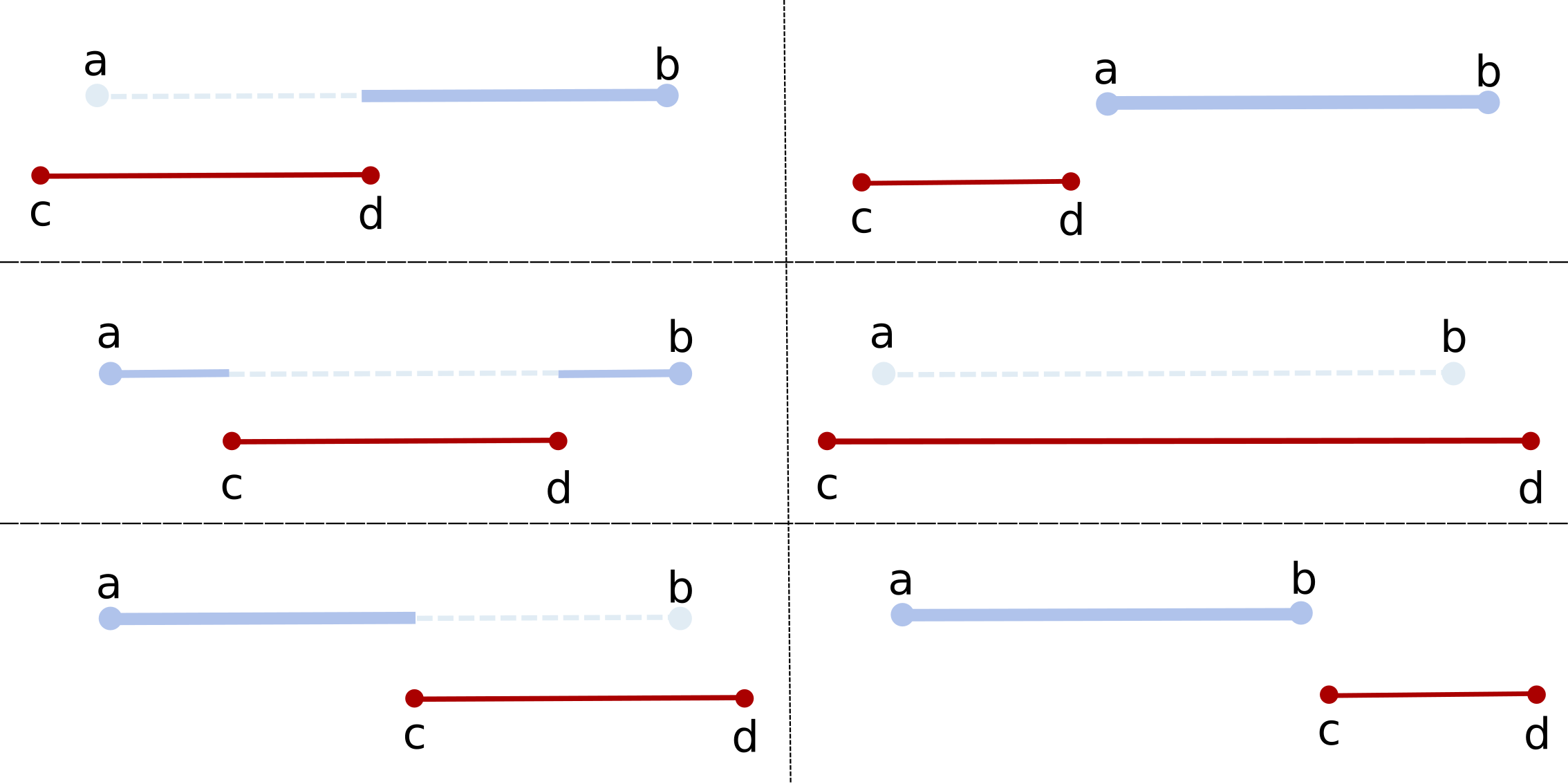
At last, if we manage to demonstrate that the set difference of two intervals is again a union of at most two intervals, then
must be elementary, considering how Cartesian products interact with set unions. This, however, follows immediately by tediously considering each of the six non-trivial cases
,
.
Figure 3: Non-trivial possibilities of the relative positions of two intervals
and
and the set difference
. From left to right:
,
,
,
,
,
.
Thus,
can be represented as a union of Cartesian products taken over these at most
intervals, i.e., as a union of boxes.
(iv)
The fact that
is elementary follows from the fact that
and
are elementary (by part 3), and that their union must therefore be elementary too (part 1).
(v)
As always, we reduce the assertion to a similar assertion made about boxes. Notice that
The third answer involving set difference is wrong in two aspects: the notation should be backslash instead of forward slash; and the rule for expanding $E\backslash F$ is wrong (the final result should be $\bigcup_{i=1}^n\bigcap_{j=1}^kE_i\backslash F_j$