Homepage › Solution manuals › Terence Tao › An Introduction to Measure Theory › Exercise 1.6.18 (Vitali-type covering lemma)
Exercise 1.6.18 (Vitali-type covering lemma)
Let be a finite collection of open balls in . Then there exists a subcollection of disjoint balls in this collection such that
Answers
Denote . At each step we will fill out the collection with the balls (obviously ), so that the resulting collection satisfies the end-condition. Thus, consider the following induction.
-
-
Define for :
Let , and enumerate its elements by . The sets are obviously disjoint (otherwise we would come to a contradiction at construction step ). We now demonstrate that
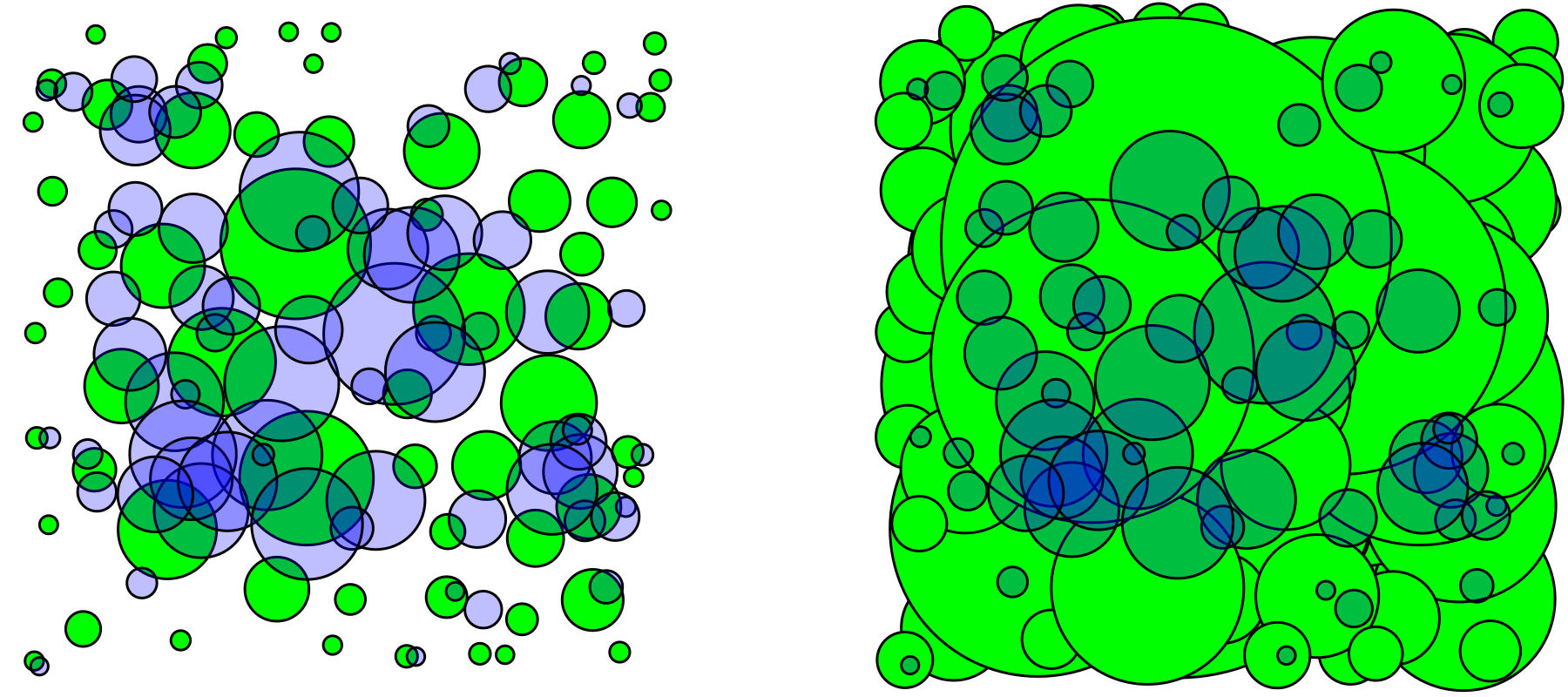
Let from the left-hand side be arbitrary. By construction, there must be a which intersects , i.e, (if this would not be the case, then would be disjoint from all and would be added to the collection as st element at least at step ). Let be the first ball in the collection with this property (i.e., all other balls before are disjoint from ). Because was chosen to be the largest amongst all balls that did not intersect , we conclude that the radius of cannot exceed that of . If and , set . Then from the triangle inequality, we see that
This implies that .