Homepage › Solution manuals › Terence Tao › An Introduction to Measure Theory › Exercise 1.6.21 (Besicovich covering lemma in one dimension)
Exercise 1.6.21 (Besicovich covering lemma in one dimension)
Let be a finite family of open intervals in (not necessarily disjoint). Show that there exist a subfamily of intervals such that
- (i)
- and
- (ii)
- Each point is contained in at most two of the .
Answers
Proof. Let denote the family of open intervals . Consider the subcollection of all intervals in that are not contained in the union of the other intervals, i.e.,
|
| (1) |
Let and enumerate the elements of by . We argue that at , it is not possible for a point to be contained in three of the intervals and that holds.
- (i)
To demonstrate that the former union is a subset of the latter, pick an arbitrary , i.e., for . If is not contained in the union of other intervals , then for some by construction and we are done. If that is again not the case, then is contained in the union of some other intervals, i.e., for some . If satisfies the requirement of our refinement, then we are done. If not, we can find another set for some . Continuing the argument in that manner, we must terminate at some , latest at some . The resulting set cannot be contained in the union of the other intervals and must thus be equal to for some as desired.
The other direction follows directly from construction.- (ii)
- Each point
is contained in at most two of the .
Suppose for the sake of contradiction that is contained in at least three refined intervals , and . Our strategy is to look for two intervals with the widest combined radius.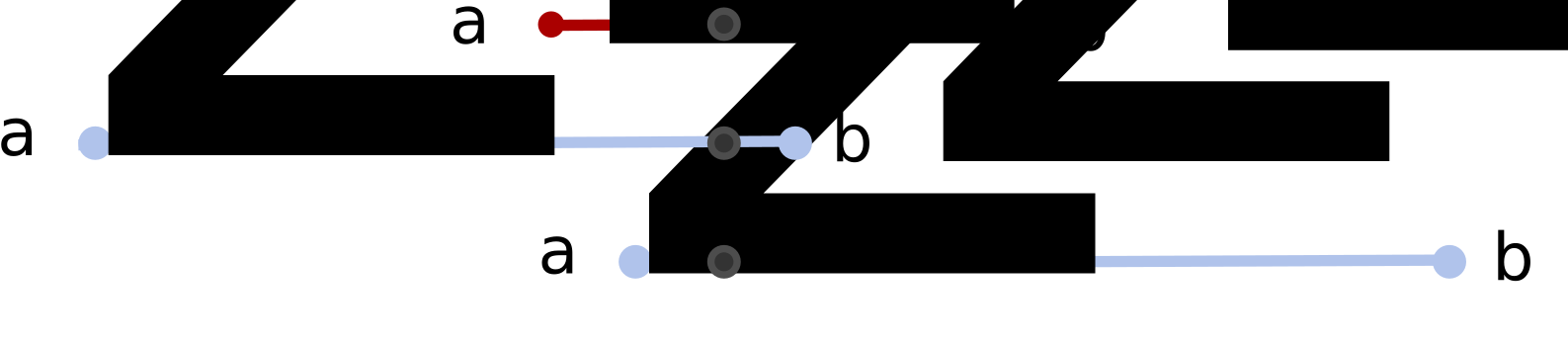
Figure 1: Out of three intervals with a non-empty intersection, the union of two of the furthest lying is always going to contain the third one. Let be the point residing furthest on the left, and let be the point residing furthest on the right. Then it is obvious that the associated intervals is going to contain the third interval, which has neither the point furthest to the left nor furthest to right. Thus, we arrive at a contradiction.