Homepage › Solution manuals › Terence Tao › An Introduction to Measure Theory › Exercise 1.6.23 (Cousin's theorem)
Exercise 1.6.23 (Cousin's theorem)
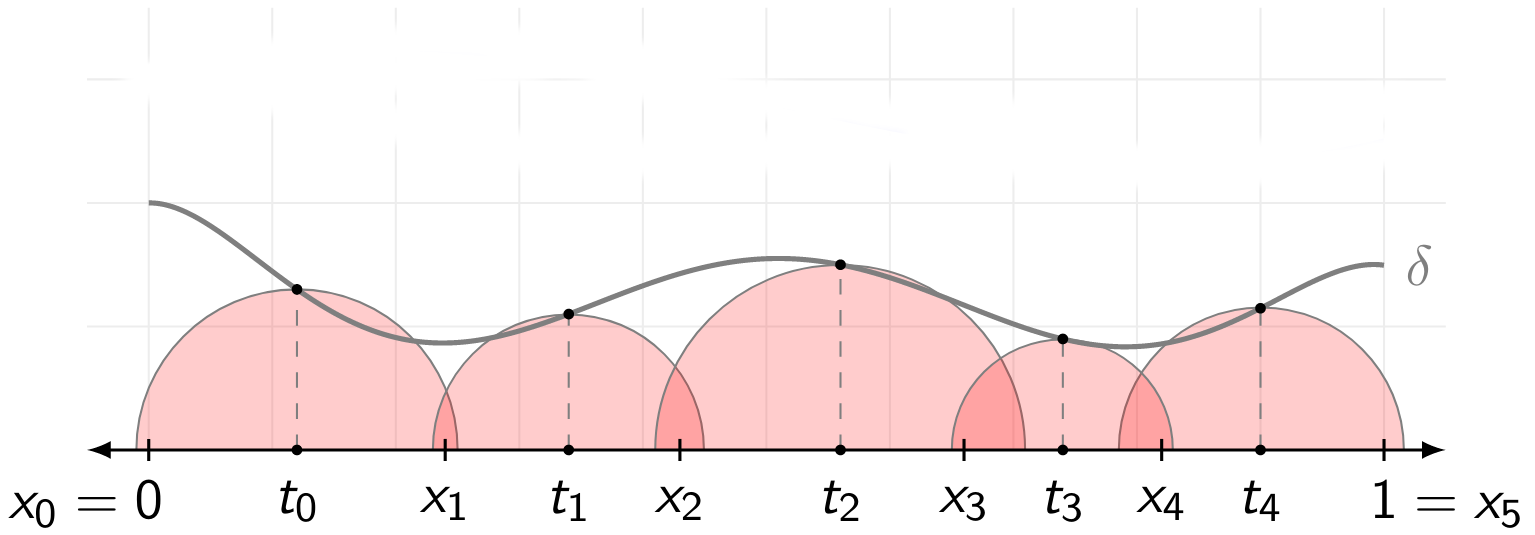
Prove Cousin’s theorem: given any function on a compact interval of positive length, there exists a partition with , together with real numbers for each and .
Answers
Proof. To construct a partition for Cousin’s theorem1 , we implement the following algorithm.
c = b - a
t = ([c,))
while (t  ):
   c = c / 2
   t = ([c,))
partition = {[a+i*c,a+(i+1)*c] for i=0,...,(b-a)/c}
Heuristically, the algorithm suggests starting with the largest possible value of that is allowed for this partition: . If the gauge function never exceeds this value, then we already have our partition where the middle point can be any point between and . If, however, does exceed somewhere, then we must search further. Splitting in half, we check whether exceeds on both halves of . If this is not the case, then we are done as we have a partition with the middle points anywhere in between. If that is not the case, we further split the interval into four parts and repeat the procedure with .
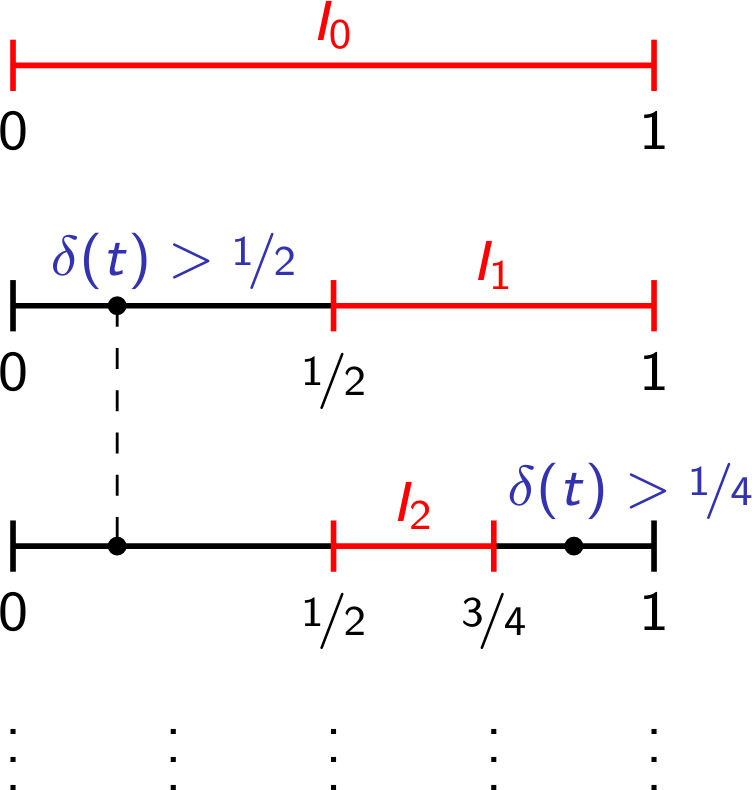
The above algorithm is guaranteed to terminate. If that would not be the case, then we could find a such that for all we would have , i.e., - a contradiction to the positivity assumption on .