Homepage › Solution manuals › Terence Tao › An Introduction to Measure Theory › Exercise 1.7.18 (Product $\sigma$-algebras)
Exercise 1.7.18 (Product $\sigma$-algebras)
Let and be measurable spaces.
- (i)
- Show that is the -algebra generated by the sets with , . In other words, is the coarsest -algebra on with the property that the product of a -measurable set and a -measurable set is always measurable.
- (ii)
- Show that is the coarsest -algebra on that makes the projection maps both measurable morphisms (see Remark 1.4.33).
- (iii)
- If , show that the sets lie in for every , and similarly that the sets lie in for every .
- (iv)
- If is measurable (with respect to ), show that the function is -measurable for every , and similarly that the function is -measurable for every .
- (v)
- If , show that the slices lie in a countably generated -algebra. In other words, show that there exists an at most countable collection of sets (which can depend on ) such that . Conclude in particular that the number of distinct slices is at most , the cardinality of the continuum. (The last part of this exercise is only suitable for students who are comfortable with cardinal arithmetic.)
Answers
- (i)
- We have to demonstrate that both generating sets result in the same
-algebra,
i.e.,
Recall that to show that two families of sets generate the same -algebra, it suffices to show that every -algebra that contains the former family of sets, contains the latter also, and conversely.
- Pick an arbitrary from the generating set of the product -algebra. Then either for some or for some . In the former case, it is obvious that . But both and ; thus, must be contained in the generating set on the right-hand side. The second case follows identically.
- Pick an arbitrary for some and . Then, it is easy to verify that . The former is the pullback of the set under the projection ; the latter set is the pullback of the set under the projection . Thus, is the intersection of two pullback sets and is therefore contained in the product -algebra.
- (ii)
- Let be an arbitrary
-algebra on the
product space .
For to make and measurable, it must at least contain the inverse image of every measurable set in and . From this, we immediate that must contain the sets of the form for and for . But this is the same as saying that must contain the generating set of the product -algebra, which is, in turn, equivalent to saying that contains the product -algebra itself.
- (iii)
- Notice that a more formal way of saying that the section
of any
set in
is
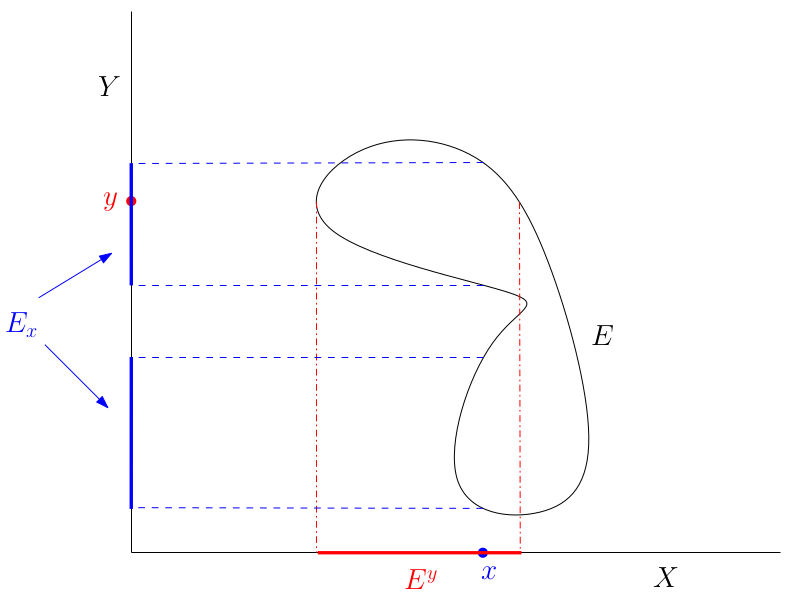
Figure 1: Example of a section of a set in . It becomes obvious that the latter form is better suited for our proof as soon as one realises that the right-hand set is a -algebra. Denote this set by .
- We have since .
-
Let , i.e., and . Then,
since is itself a -algebra. Similarly, .
-
Let be a sequence of -measurable sets. Using elementary set-theoretic laws, we obtain
Similarly
To demonstrate that one -algebra is contained in another, it suffices to demonstrate that the generating set of the former -algebra is contained in the second -algebra. We use the generating set from the part (i) of this proof, i.e., the collection . An important observation that one immediately makes while playing around with sections is that
But this practically means that
Thus, , as desired.
- (iv)
- If is
-measurable then
for any set in the
target -algebra,
which is
in because
. Similarly
for .
The property of the section of an inverse that we have used in the previous argument can be proven as follows:and similarly for
- (v)
- this part is yet to be solved by a student who is comfortable with cardinal arithmetic.