Homepage › Solution manuals › Yaser Abu-Mostafa › Learning from Data › Exercise 9.18
Exercise 9.18
Answers
def calc_Eout_ex_918(Qf, train_xs, train_ys, test_xs, test_ys, lambda_t = 0):
    #Fit with models of degree Qf and compute the E_{out}
    Z = data.polynomial_transform(Qf, train_xs)
    w = np.matmul(np.linalg.inv(np.matmul(Z.transpose(), Z) + lambda_t),
                  np.matmul(Z.transpose(), train_ys))
    #print(f"w.shape: {w.shape}")
    Ein = data.calc_Eout(w, train_xs, train_ys)
    Eout = data.calc_Eout(w, test_xs, test_ys)
    return Ein, Eout

def calc_permutation_estimate(d_eff, train_ys, Ein):
    #Compute the Permutation Estimate for Linear Regression, equation (9.6)
    N = train_ys.shape[0]
    sigma_hat2 = N * np.var(train_ys)/ (N-1)
    est = 2 * sigma_hat2 * d_eff/N
    est += Ein
    return est

def calc_fpe_estimate(N, d_eff, Ein):
    #Final prediction error, section 9.5.4
    p = N/d_eff
    est = (p+1)*Ein/(p-1)
    return est

def calc_vc_estimate(N, d_eff, Ein):
    p = N/d_eff
    r1 = np.sqrt(p)*Ein
    r2 = np.sqrt(p) - np.sqrt(1 + np.log(p)+ np.log(N)/2/d_eff)
    est = r1/r2
    return est


def compute_leave_one_out_estimate(H, y_hat, y):
    N = y_hat.shape[0]
    est = 0

    for n in np.arange(N):
        yhat_n = y_hat[n]
        yn = y[n]
        Hnn = H[n,n]
        r = (yhat_n - yn)/(1-Hnn)
        est += r**2
    est = est / N
    return est


def run_one_experiment_ex_918(N, test_N, max_target_degree, max_hypo_degree, lambda_t):
    sigma_square = data.generate_random_numbers01(1, 1)
    Qf = np.random.choice(max_target_degree+1, 1)
    normalized_aqs = data.generate_target_coefficients(Qf)
    train_xs, train_ys = data.generate_data_set(N, normalized_aqs, sigma_square)
    test_xs, test_ys = data.generate_data_set(test_N, normalized_aqs, sigma_square)

    orders = np.arange(0,max_hypo_degree+1)
    Eins, Eouts = [], []
    Est_vcs, Est_loocvs, Est_perms, Est_fpes = [], [], [], []
    for order in orders:
        Ein, Eout = calc_Eout_ex_918(order, train_xs, train_ys, test_xs, test_ys)

        Z = data.polynomial_transform(order, train_xs)
        H = lm.compute_H(Z, lambda_t) #full H, Need use transformed Z to compute
        y_hat = lm.compute_y_hat(H, train_ys)

        eff_dof = lm.calc_effective_dof(H) #effective degree of freedom
        #print(f"{eff_dof}")
        if eff_dof <= 1.0e-18:
            eff_dof = 1.0e-18
        est_vc = calc_vc_estimate(N, eff_dof, Ein)
        est_loocv = compute_leave_one_out_estimate(H, y_hat, train_ys)
        est_perm = calc_permutation_estimate(eff_dof, train_ys, Ein)
        est_fpe = calc_fpe_estimate(N, eff_dof, Ein)

        Eins.append(Ein)
        Eouts.append(Eout)
        Est_vcs.append(est_vc)
        Est_loocvs.append(est_loocv)
        Est_perms.append(est_perm)
        Est_fpes.append(est_fpe)
    return Eouts, Est_vcs, Est_loocvs, Est_perms, Est_fpes, Eins
N = 100
test_N = 100
max_target_degree = 30
max_hypo_degree = 20
lambda_t = 0

max_exps = 10000
Eins, Eouts = [], []
Est_vcs, Est_loocvs, Est_perms, Est_fpes = [], [], [], []
best_outs, best_ins, best_vcs, best_cvs, best_perms, best_fpes = [], [], [], [], [], []
reg_ins, reg_vcs, reg_cvs, reg_perms, reg_fpes = [], [], [], [], []
for e in np.arange(max_exps):
    if e %1000 == 1:
        print(f"--- Current iteration : {e}")
    Eouts1, Est_vcs1, Est_loocvs1, Est_perms1, Est_fpes1, Eins1 = run_one_experiment_ex_918(N, test_N,
                                                                             max_target_degree,
                                                                             max_hypo_degree,
                                                                             lambda_t)


    best_out = np.argmin(np.array(Eouts1))
    optimal = np.min(np.array(Eouts1))
    best_in = np.argmin(np.array(Eins1))
    best_vc = np.argmin(np.array(Est_vcs1))
    best_cv = np.argmin(np.array(Est_loocvs1))
    best_perm = np.argmin(np.array(Est_perms1))
    best_fpe = np.argmin(np.array(Est_fpes1))

    best_outs.append(best_out)
    best_ins.append(best_in)
    best_vcs.append(best_vc)
    best_cvs.append(best_cv)
    best_perms.append(best_perm)
    best_fpes.append(best_fpe)

    regret_out = 0
    regret_in = (Eouts1[best_in] - optimal)/optimal
    regret_vc = (Eouts1[best_vc] - optimal)/optimal
    regret_cv = (Eouts1[best_cv] - optimal)/optimal
    regret_perm = (Eouts1[best_perm] - optimal)/optimal
    regret_fpe = (Eouts1[best_fpe] - optimal)/optimal

    reg_ins.append(regret_in)
    reg_vcs.append(regret_vc)
    reg_cvs.append(regret_cv)
    reg_perms.append(regret_perm)
    reg_fpes.append(regret_fpe)

    Eouts.append(Eouts1)
    Est_vcs.append(Est_vcs1)
    Est_loocvs.append(Est_loocvs1)
    Est_perms.append(Est_perms1)
    Est_fpes.append(Est_fpes1)
    Eins.append(Eins1)


Eouts = np.mean(np.array(Eouts), axis=0)
Est_vcs = np.mean(np.array(Est_vcs), axis=0)
Est_loocvs = np.mean(np.array(Est_loocvs), axis=0)
Est_perms = np.mean(np.array(Est_perms), axis=0)
Est_fpes = np.mean(np.array(Est_fpes), axis=0)

b_out = np.mean(np.array(best_outs))
b_in = np.mean(np.array(best_ins))
b_vc = np.mean(np.array(best_vcs))
b_cv = np.mean(np.array(best_cvs))
b_perm = np.mean(np.array(best_perms))
b_fpe = np.mean(np.array(best_fpes))

reg_in = np.mean(np.array(reg_ins))
reg_vc = np.mean(np.array(reg_vcs))
reg_cv = np.mean(np.array(reg_cvs))
reg_perm = np.mean(np.array(reg_perms))
reg_fpe = np.mean(np.array(reg_fpes))
--- Current iteration : 1
--- Current iteration : 1001
--- Current iteration : 2001
--- Current iteration : 3001
--- Current iteration : 4001
--- Current iteration : 5001
--- Current iteration : 6001
--- Current iteration : 7001
--- Current iteration : 8001
--- Current iteration : 9001
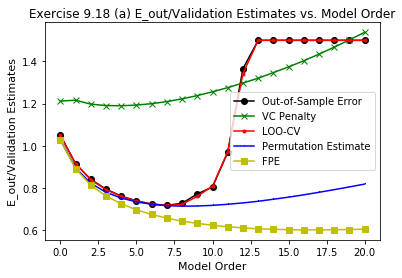
orders = np.arange(max_hypo_degree+1)
yub = 1.5
Est_loocvs_f = np.clip(Est_loocvs, 0, yub)
Eouts_f = np.clip(Eouts, 0, yub)
xxs = [orders, orders, orders, orders, orders]
yys = [Eouts_f, Est_vcs, Est_loocvs_f, Est_perms, Est_fpes]
myplot.plt_plot(xxs, yys, 'plot', ['k', 'g', 'r', 'b', 'y'], ['o', 'x', '.', ',', 's'],
                ['Out-of-Sample Error', 'VC Penalty', 'LOO-CV', 'Permutation Estimate',
                'FPE'],
        title = 'Exercise 9.18 (a) E_out/Validation Estimates vs. Model Order', yscale = None, ylb = 0, yub = 1.2,
        xlb = None, xub = None, xlabel = 'Model Order', ylabel = 'E_out/Validation Estimates',
        legends = ['']*6, legendx = None, legendy = None, marker_sizes=[15]*5)
#### Exercise 9.18 (d) Order Selection
names = ['Eout', 'Ein', 'Ecv', 'Eperm', 'Efpe', 'Evc']
regs = [0, reg_in, reg_cv, reg_perm, reg_fpe, reg_vc]
orders = [b_out, b_in, b_cv, b_perm, b_fpe, b_vc]
df = pd.DataFrame({'name':names, 'Regret': regs, 'Avg. Order': orders})
df
#### Exercise 9.18 (b)

def run_one_experiment_918_b(N, test_N, max_target_degree, order, lambdas):
    sigma_square = data.generate_random_numbers01(1, 1)
    Qf = np.random.choice(max_target_degree+1, 1)
    normalized_aqs = data.generate_target_coefficients(Qf)
    train_xs, train_ys = data.generate_data_set(N, normalized_aqs, sigma_square)
    test_xs, test_ys = data.generate_data_set(test_N, normalized_aqs, sigma_square)
    #print(f"sigma_squre = {sigma_square}, Qf={Qf}, order = {order}")
    Eins, Eouts = [], []
    Est_vcs, Est_loocvs, Est_perms, Est_fpes = [], [], [], []
    for lambda_t in lambdas:
        Ein, Eout = calc_Eout_ex_918(order, train_xs, train_ys, test_xs, test_ys, lambda_t)

        Z = data.polynomial_transform(order, train_xs)
        H = lm.compute_H(Z, lambda_t) #full H, Need use transformed Z to compute
        y_hat = lm.compute_y_hat(H, train_ys)
        #print(f"lambda = {lambda_t}, Ein = {Ein}, Eout = {Eout}")
        eff_dof = lm.calc_effective_dof(H) #effective degree of freedom
        #print(f"effective dof: {eff_dof}")
        if eff_dof <= 1.0e-18:
            eff_dof = 1.0e-18
        est_vc = calc_vc_estimate(N, eff_dof, Ein)
        est_loocv = compute_leave_one_out_estimate(H, y_hat, train_ys)
        est_perm = calc_permutation_estimate(eff_dof, train_ys, Ein)
        est_fpe = calc_fpe_estimate(N, eff_dof, Ein)

        Eins.append(Ein)
        Eouts.append(Eout)
        Est_vcs.append(est_vc)
        Est_loocvs.append(est_loocv)
        Est_perms.append(est_perm)
        Est_fpes.append(est_fpe)
    return Eouts, Est_vcs, Est_loocvs, Est_perms, Est_fpes, Eins
N = 100
test_N = 100
max_target_degree = 10
hypo_degree = 5

max_exps = 10000
Eins, Eouts = [], []
Est_vcs, Est_loocvs, Est_perms, Est_fpes = [], [], [], []
best_outs, best_ins, best_vcs, best_cvs, best_perms, best_fpes = [], [], [], [], [], []
reg_ins, reg_vcs, reg_cvs, reg_perms, reg_fpes = [], [], [], [], []

lambdas = np.hstack([np.arange(0, 0.01, 0.001), np.arange(0.01, 0.1, 0.01), np.arange(0.1, 1, 0.1),
                     np.arange(1, 15, 1), np.arange(10, 310, 10)])

for e in np.arange(max_exps):
    if e %1000 == 1:
        print(f"--- Current iteration : {e}")
    Eouts1, Est_vcs1, Est_loocvs1, Est_perms1, Est_fpes1, Eins1 = run_one_experiment_918_b(N,
                                                                                    test_N,
                                                                                    max_target_degree,
                                                                                    hypo_degree,
                                                                                    lambdas)

    best_out = np.argmin(np.array(Eouts1))
    optimal = np.min(np.array(Eouts1))
    best_in = np.argmin(np.array(Eins1))
    best_vc = np.argmin(np.array(Est_vcs1))
    best_cv = np.argmin(np.array(Est_loocvs1))
    best_perm = np.argmin(np.array(Est_perms1))
    best_fpe = np.argmin(np.array(Est_fpes1))

    best_outs.append(lambdas[best_out])
    best_ins.append(lambdas[best_in])
    best_vcs.append(lambdas[best_vc])
    best_cvs.append(lambdas[best_cv])
    best_perms.append(lambdas[best_perm])
    best_fpes.append(lambdas[best_fpe])

    regret_out = 0
    regret_in = (Eouts1[best_in] - optimal)/optimal
    regret_vc = (Eouts1[best_vc] - optimal)/optimal
    regret_cv = (Eouts1[best_cv] - optimal)/optimal
    regret_perm = (Eouts1[best_perm] - optimal)/optimal
    regret_fpe = (Eouts1[best_fpe] - optimal)/optimal

    reg_ins.append(regret_in)
    reg_vcs.append(regret_vc)
    reg_cvs.append(regret_cv)
    reg_perms.append(regret_perm)
    reg_fpes.append(regret_fpe)


    Eouts.append(Eouts1)
    Est_vcs.append(Est_vcs1)
    Est_loocvs.append(Est_loocvs1)
    Est_perms.append(Est_perms1)
    Est_fpes.append(Est_fpes1)

Eouts = np.mean(np.array(Eouts), axis=0)
Est_vcs = np.mean(np.array(Est_vcs), axis=0)
Est_loocvs = np.mean(np.array(Est_loocvs), axis=0)
Est_perms = np.mean(np.array(Est_perms), axis=0)
Est_fpes = np.mean(np.array(Est_fpes), axis=0)

b_out = np.mean(np.array(best_outs))
b_in = np.mean(np.array(best_ins))
b_vc = np.mean(np.array(best_vcs))
b_cv = np.mean(np.array(best_cvs))
b_perm = np.mean(np.array(best_perms))
b_fpe = np.mean(np.array(best_fpes))

reg_in = np.mean(np.array(reg_ins))
reg_vc = np.mean(np.array(reg_vcs))
reg_cv = np.mean(np.array(reg_cvs))
reg_perm = np.mean(np.array(reg_perms))
reg_fpe = np.mean(np.array(reg_fpes))
--- Current iteration : 1
--- Current iteration : 1001
--- Current iteration : 2001
--- Current iteration : 3001
--- Current iteration : 4001
--- Current iteration : 5001
--- Current iteration : 6001
--- Current iteration : 7001
--- Current iteration : 8001
--- Current iteration : 9001
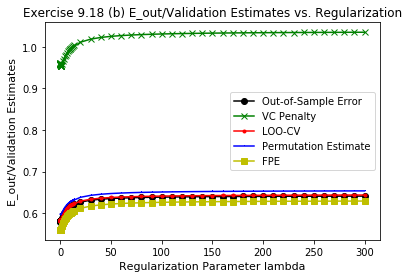
yub = 1.5
Eouts_f = np.clip(Eouts, 0, yub)
Est_loocvs_f = np.clip(Est_loocvs, 0, yub)
xxs = [lambdas, lambdas, lambdas, lambdas, lambdas]
yys = [Eouts_f, Est_vcs, Est_loocvs_f, Est_perms, Est_fpes]
myplot.plt_plot(xxs, yys, 'plot', ['k', 'g', 'r', 'b', 'y'], ['o', 'x', '.', ',', 's'],
                ['Out-of-Sample Error', 'VC Penalty', 'LOO-CV', 'Permutation Estimate',
                'FPE'],
        title = 'Exercise 9.18 (b) E_out/Validation Estimates vs. Regularization', yscale = None, ylb = 0, yub = yub,
        xlb = None, xub = None, xlabel = 'Regularization Parameter lambda', ylabel = 'E_out/Validation Estimates',
        legends = ['']*6, legendx = None, legendy = None, marker_sizes=[1]*5)
#### Exercise 9.18 (d) Lambda Selection
names = ['Eout', 'Ein', 'Ecv', 'Eperm', 'Efpe', 'Evc']
regs = [0, reg_in, reg_cv, reg_perm, reg_fpe, reg_vc]
avg_lambdas = [b_out, b_in, b_cv, b_perm, b_fpe, b_vc]
df = pd.DataFrame({'name':names, 'Regret': regs, 'Avg. Lambda': avg_lambdas})
df
(b)
Somehow I can’t get the same graph as in Figure 9.8(b), not sure where I did wrong. :(
(c)
The VC estimate is weaker but sufficient.
